
The COVID-19 pandemic tested every aspect of Louisiana's health care system. It also tested Lift Louisiana's resolve. In mid-March 2020, Louisiana issued orders limiting non-essential medical services statewide. The governor did not intend for the mandate to restrict abortion care, but its broad scope left clinics at risk of losing their licenses if they operated without explicit state approval. Anti-abortion advocates and some state politicians seized on that ambiguity, using the pandemic as a pretext to try to advance their long-standing goal of closing Louisiana's abortion clinics, and Lift, once again, was called to hold the line for abortion access.
In March 2020, the CDC released guidance encouraging hospitals and state health departments to postpone elective, non-time-sensitive medical procedures in order to preserve personal protective equipment and hospital capacity. Louisiana Right to Life pushed to have that guidance applied to abortion care, and though the state's order was never intended to reach abortion, its broad, vaguely written scope created immediate uncertainty for providers and patients across the state.
There were two major problems with treating abortion as deferrable care. First, abortion is time-sensitive health care. Delaying care can mean preventing access altogether. Second, the uncertainty threatened to force patients to travel for abortion care during a period when public health officials were urging people to stay home and avoid unnecessary travel. What may have appeared to be a technical policy question became an immediate crisis for people seeking abortion care.There were two major problems with this directive.
Rather than clarify that abortion fell outside the order, the Louisiana Department of Health punted the question to the state Attorney General's office. The AG's office wasted no time: it immediately issued press releases calling for the closure of Louisiana's three remaining abortion clinics. Then, in an unprecedented move, the office sent law enforcement agents to storm the clinics, demanding access to patient records.
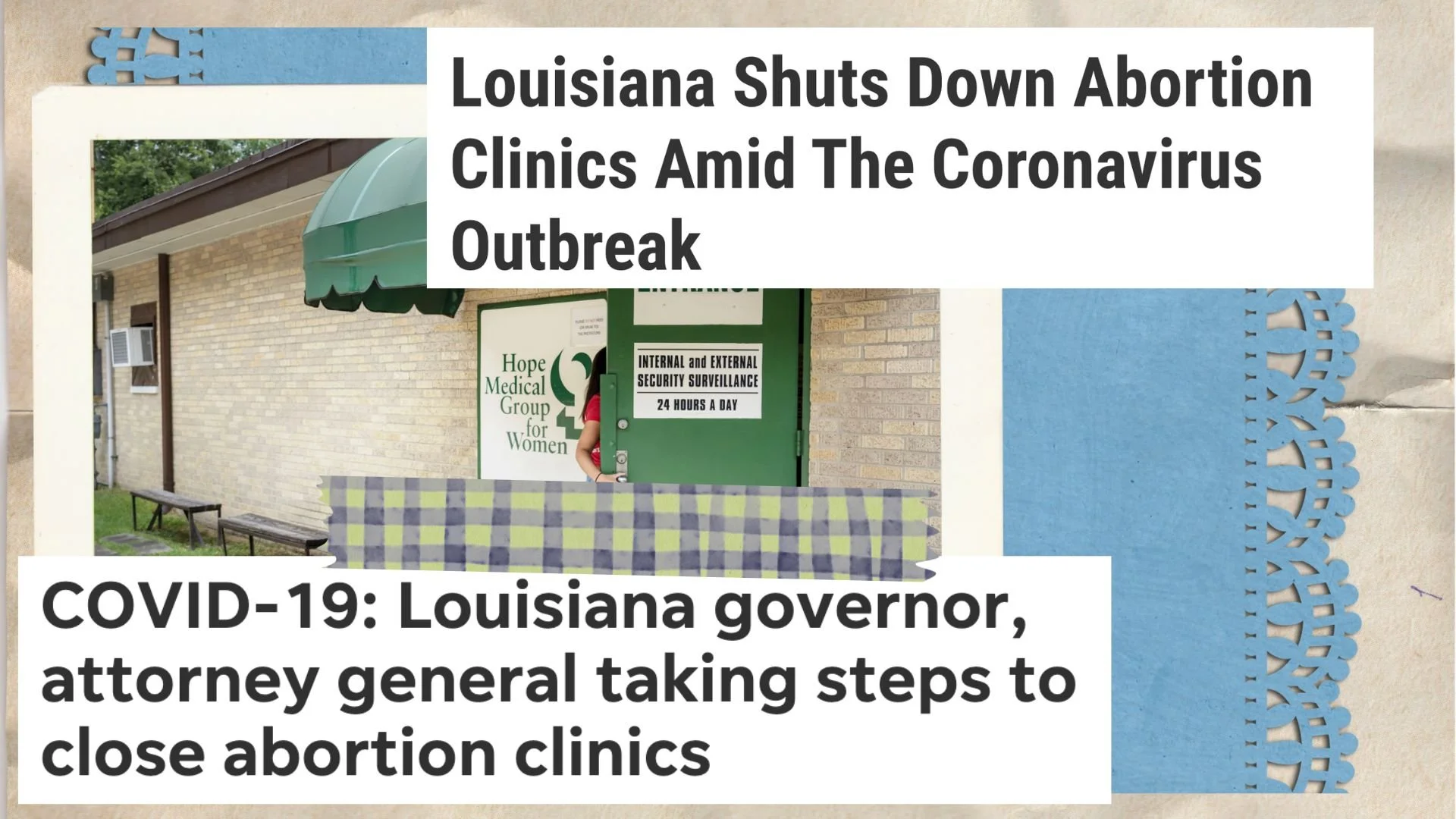
In response, Lift Louisiana's co-founder, attorney Ellie Schilling, worked alongside the Center for Reproductive Rights to challenge the state's actions. She also served as a lifeline for Louisiana's abortion clinics — coordinating with providers, fielding frantic calls from clinic staff, interpreting rapidly changing state guidance, and helping clinics navigate an increasingly confusing and uncertain legal landscape. Meanwhile, anti-abortion protesters escalated their presence outside clinics, congregating in numbers that raised their own COVID risks, even as they argued that clinics were creating unnecessary health risks for their patients. When law enforcement agents arrived at clinics demanding patient records without legal authority to do so, Schilling was on the phone with clinic staff almost immediately, advising them to decline the requests and direct the officials to leave.
While Ellie focused on building the legal strategy, executive director and co-founder Michelle Erenberg and the rest of the staff team at Lift Louisiana worked to raise public awareness of the tactics being employed by Attorney General Jeff Landry and his office aimed at shutting down clinics or, at the very least, intimidating clinic employees and patients.
Lift Louisiana recognized that it needed to act immediately to protect abortion access and the other health care services these clinics provide. In early April, Lift proactively sued the state, acting quickly enough that none of Louisiana's three abortion clinics were forced to close, even briefly. The lawsuit argued that a public health emergency does not suspend constitutional protections and that Louisiana could not use the pandemic as a pretext to eliminate access to abortion care. Lift was able to resolve the dispute directly with the state, reaching an agreement that ensured abortion care could continue, without unlawful interference, at all three clinics. The suit was dismissed without prejudice.
“One should think about suing our government as often as possible…otherwise it just makes them even more likely to just think there are no consequences to their actions.”
The outcome demonstrates the value of sustained investment in organizations like Lift Louisiana, whose ability to mobilize rapid legal advocacy can make the difference between losing and protecting abortion access during moments of crisis.
This case exemplifies what "holding the line" has meant throughout Lift Louisiana's history. When state officials attempted to use a public health emergency to eliminate abortion access, Lift responded with strategic partnerships, rapid legal advocacy, and an unwavering commitment to protecting care. Litigation cannot solve every legal challenge standing between Louisianans and reproductive freedom. But moments like this demonstrate why it remains an essential tool for holding the government accountable and defending access when it's under immediate threat.
This work was made possible in part by funding from the Urgent Action Fund for Women's Human Rights, the Tides Stronger Together Fund, and the Collaborative for Gender + Reproductive Equity, a donor-advised fund of Rockefeller Philanthropy Advisors.